

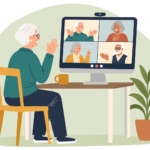
For older adults, social connection does not always require gathering in the same room. Sometimes it begins by turning on a computer and seeing a familiar face on the screen.
Since 2020, JFS Akron has offered a growing schedule of virtual programs for older adults. What began as a way to keep people connected during the pandemic has developed into something much more lasting: a small but active community whose members learn together, share experiences and look forward to seeing one another week after week.
“There aren’t a ton of people. It’s not like 50 people are joining,” says Buffy Ramos, director of Older Adult Services at JFS Akron. Instead, a core group of five to 10 participants regularly attends. They know one another, notice when someone is missing and have developed friendships that extend beyond the computer screen. “If someone doesn’t show up, the other ladies are like, ‘Where’s Carrie? Where’s Lois? Is she sick? What’s going on?’” Buffy says. “That sense of, ‘I miss my friend.’ That’s true community.”
Some friendships existed before the virtual programs. Others developed through them. Participants have come to know one another as “virtual friends,” and the consistency of having a program available each week gives them something—and someone—to count on.
That consistency can be especially meaningful for an older adult who lives alone or may go several days without leaving home. A virtual gathering may be only one interaction during the week, Buffy explains, but it provides a familiar face and a dependable connection. Participants are also lifelong learners who want opportunities to remain curious and engaged.
Virtual programming is not intended to replace in-person socialization. Sitting across a table from a friend, sharing a meal or traveling together offers experiences that cannot be duplicated online. But getting to an in-person program can involve transportation, mobility, weather and other barriers. Virtual programs offer another way to participate—from home. And one format does not work for everyone. “For the people who join virtual, they are committed. They love it,” Buffy says. “Every older adult has different needs and you’ve got to meet them where they are.” Some participants may regularly attend only the movie club, while others are most interested in Jewish programming or another particular topic.
That person-centered approach guides Nicki Embly, JFS Akron’s coordinator of virtual programs. Instead of simply filling a calendar with activities, Nicki asks participants what they want to do and builds programs around their interests.
When she developed the Spice It Up series, for example, she asked participants to look through their spice racks and identify spices they had not used in years. Those answers helped shape future sessions, encouraging participants to experiment with ingredients they already had and add variety to their meals. Other virtual offerings have included Jewish-centered programs and a popular travel series.
One of the longest-running favorites is the virtual movie club. Nicki carefully selects films, gives participants a question to consider while watching and leads a conversation afterward about themes, characters and connections between the story and the world today. Participants are invited to log on early simply to kibitz and catch up.
The movies themselves are deliberately varied—true stories, historical films, foreign films, Jewish-themed selections and, at Hanukkah, a much-anticipated Hallmark movie. Nicki has been curating the selections for five years. The word curating is important. Nicki previews films rather than simply choosing something popular, considering whether each selection will interest participants, encourage discussion and be appropriate for the group. She prepares questions, follows up afterward and sends additional information or recipes when participants request them.
Buffy describes the result as “a little community” or “a little club” that Nicki both leads and has become part of herself. That may be the greatest similarity between virtual and in-person socialization. The technology is simply the place where people meet. What matters is what happens once they arrive.
They recognize one another. They ask questions. They learn. They laugh. They notice when someone is missing. And they know that next week, the familiar faces will be there again. For an older adult who cannot—or simply does not want to—leave home for every activity, that screen can become a window to a very real community.





 JFS Akron helps individuals and families with